Mason's Gain Formula and Control Canonical Forms
Introduction
Pop quiz: what’s the transfer function $H(s) = V_{out} / V_{in}$ in the following circuit?
Assuptions:
- $C_c$ is a big coupling capacitor.
- No channel-length modulation.
- You don’t have to solve for DC, all small signal parameters are given. Don’t assume unspecified parameters, for example $r_o$, $C_g$, etc.
- The circuit is linear.
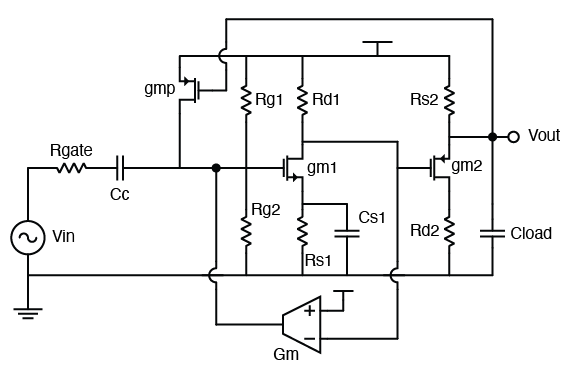
OK this circuit does look a bit intimidating. For entry-level analog circuit class takers, they might take out pencil to work through the analysis, but it’s super tedious, time consuming and error-prone.
Look at the circuit, what is the main reason that makes analysis difficult? Feedback. Not just one feedback path, there are two feedbacks from each of the two stages rendering the overall analysis not so straightforward. However, we are going to introduce a very elegant mathematical tool to deal with all these kinds of closed-loop structures.
Mason’s Gain Formula
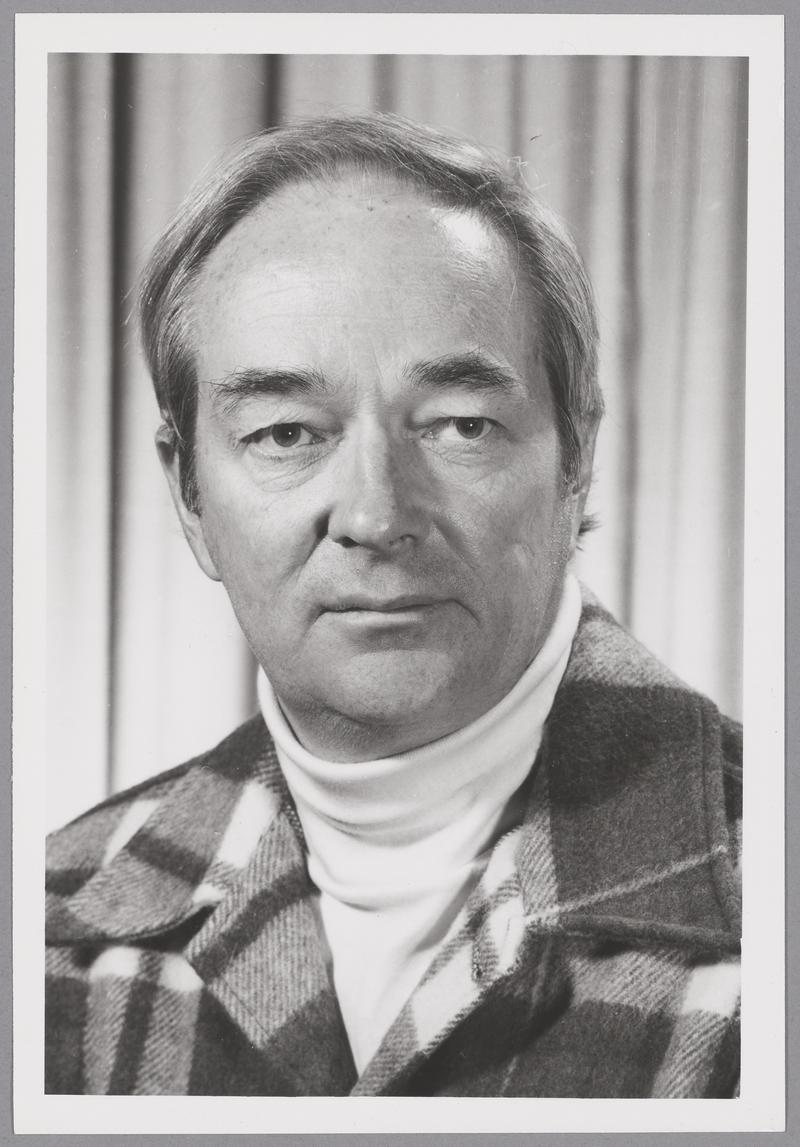
Samuel Jefferson Mason is born in 1921. As a distinguished electronics engineer, his most famous scientific contributions are Mason’s invariant and Mason’s rule, or Mason’s gain formula, both named after him.